What is Show-Don't-Tell
If you are new to writing, you may not have heard of the tool “show-don’t-tell” when it comes to description. However, this technique can be crucial to add necessary depth to your writing.
By the end of this blog post, you will understand how to apply this skill on your own.
To quote reedsyblog and their article “Show, Don’t Tell: Tips and Examples of The Golden Rule,” written by Martin Cavannagh, show-don’t-tell is a
“writing technique in which story and characters are related through sensory details and actions rather than exposition. It fosters a more immersive writing style for the reader, allowing them to “be in the room” with the characters.”
Why Showing Matters
Instead of telling your reader what is happening, show them. While a lot of authors choose to discuss how certain events, emotions, and images appear in plain writing, the reader can lose a lot of description. When you tell them what they are supposed to imagine, you are actually hindering their chance at using their imagination and allowing your story to be interpreted on their own.
Telling the reader can actually make your writing plain and still. You are also making the writing a bit too accessible, which, inevitably, creates easy reading.
Easy reading lacks depth, drama, room for imagination, and the invitation for your reader to relate more to your characters. Show the reader what they should picture during dramatic moments. Tell the reader what is happening when you wish to be factual and brief.
Defining Telling
When describing something in your writing plainly and informatively, you are telling. In other words, you are telling the reader what to think, see, and feel.
You will use both showing and telling in certain parts of your story, but it is important to differentiate between the two.
To quote Jericho Writers and their article “Novel writing- Show, Don’t Tell: What It Means And Why It Matters” by Harry Bingham,
“As we’ll see, “Show, Don’t Tell” is good advice in certain circumstances. Not just good advice, in fact, but absolutely essential to any half-decent novel.
At the same time, virtually every novel ever written contains passages that are told, not shown . . . and that’s fine. You just have to understand which mode of writing to use where.”
Example
Here is an example of telling:
Dean felt sad that she would never be apart of his life again.
Let’s break this down. When you are moving quickly between scenes, some details can be quickly described before moving on. For this example, when you are telling the reader how a character is feeling, you need to be careful you aren’t taking away their opportunity to picture how deeply sad they are, or how your reader pictures someone described as sad.
Defining Showing
When you wish to go more in-depth with your description, show your reader what is taking place and let them draw conclusions about why. By showing, you take the time to be detailed.
Going back to the earlier example, let’s change from telling the reader to showing them:
Dean pictured her smile, her voice, the mannerisms natural to her countenance and felt his eyes swell with tears. He sat down on his bed, which felt cold and stiff now, and wrapped his arms around himself. He starred blankly at the empty space next to him, and heard his throat start choking on the misery constricting his body.
Disection of Showing
By comparing the two examples, what jumps out at you?
- Perhaps how much longer the showing example was than the telling example.
- Or, did you notice more descriptive language in the showing example?
- How did each make you feel? What helped you picture the emotion of loss better?
Determining When to Show vs Tell
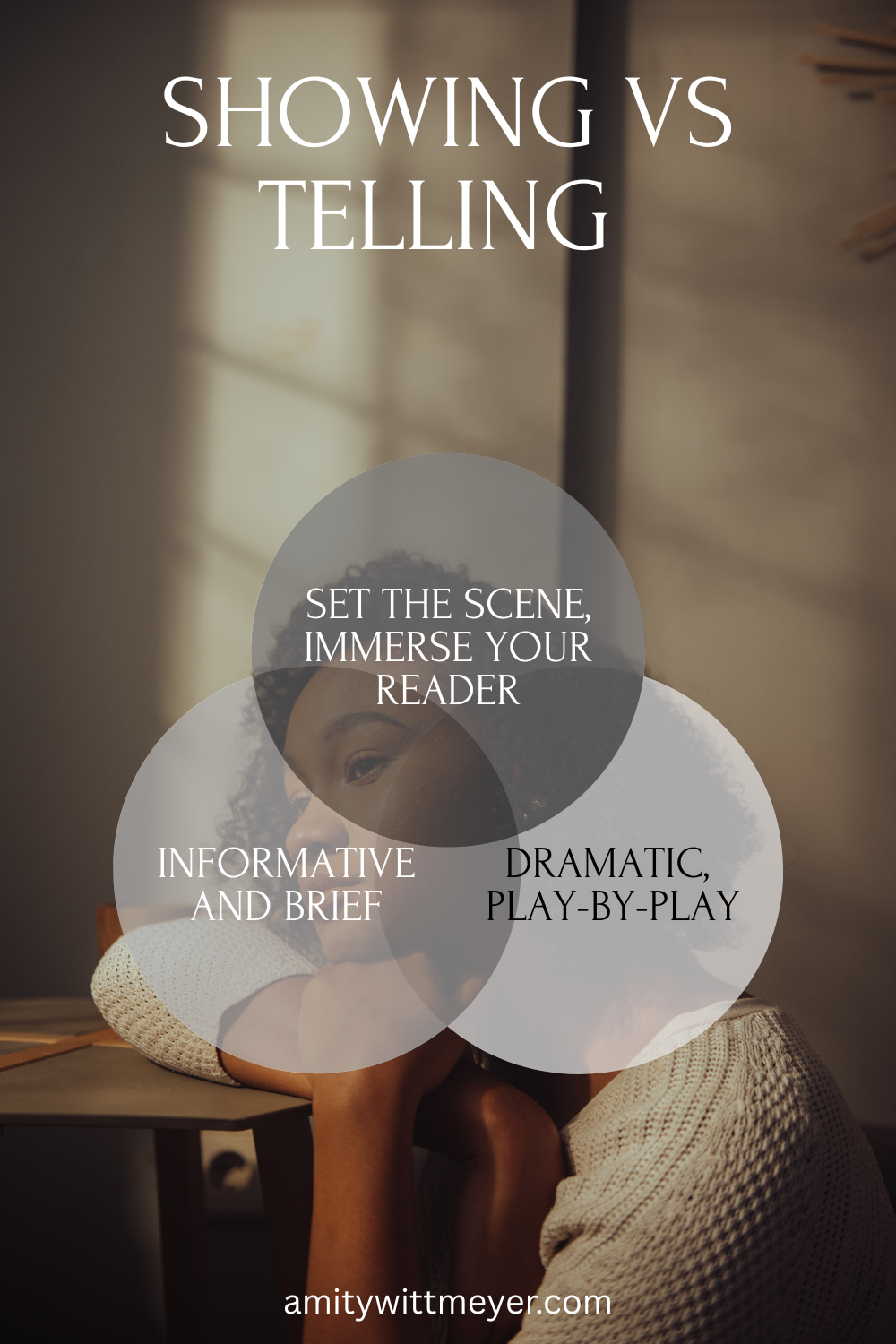
Now, both showing and telling are natural and necessary in text. Again, both are used for description. The choice is yours, which aspect of your story needs further depth by utilizing the showing technique shown above.
From the above example, depending on how long you want to dwell on the situation of, in this case, losing someone, and how important that is to your character, you should consider showing. Showing is dramatic and helps your reader immerse themselves in your story.
In contrast, if you need to move swiftly through a scene or when describing a setting, use telling.
How to Change from Telling to Showing
When you realize you want a scene to play out in real time and have the reader fully imagine what is happening, use showing. If you wish to inform the reader of something quickly and definitely, use telling.
If you start writing your story and reread it to find that you are not showing the reader what is happening often enough, here’s how to change to show them.
Interruption
Want to learn to understand descriptive writing? Check out the blog post below for information and prompts to help you practice.
Example
Picture this: you are describing the setting for a new location your character is about to explore.
Here’s what you start with:
The abandoned house was very tall, and Phineus was scared to enter, reasoning with himself that it was a waste of time. He decided that because of his experience with ghosts, he should search for his lost photograph another day.
Breaking it Down
This example is already compelling and informative to the reader. You get your setting, the character’s emotions and thoughts all wrapped up with a pretty bow.
If you really want your reader to be immersed in this particular scene with this character, however, you need to show them. Pause. Be dramatic and detailed. Lose the option to state the obvious. Instead, describe the scene like it were an audio description from a movie.
Changing Telling to Showing
Now, let’s show the reader what is happening and get them in the character’s shoes, sort of speaking.
Alterations:
Looking up, Phineus’ head touched his back before his eyes reached the top of the house. Many windows were punctuated with broken glass, looking like spiderwebs. He could hear the moaning wind going in and out of every exposed hole or crack. Phineus felt his teeth clicking together, and underneath the hand on his chest, his pulsing heart beat a rapid rhythm; and he pictured that translucent man standing in the corner of his old apartment once more. Hardly taking breaths, he turned his body away, forgetting the photograph entirely.
Comparing
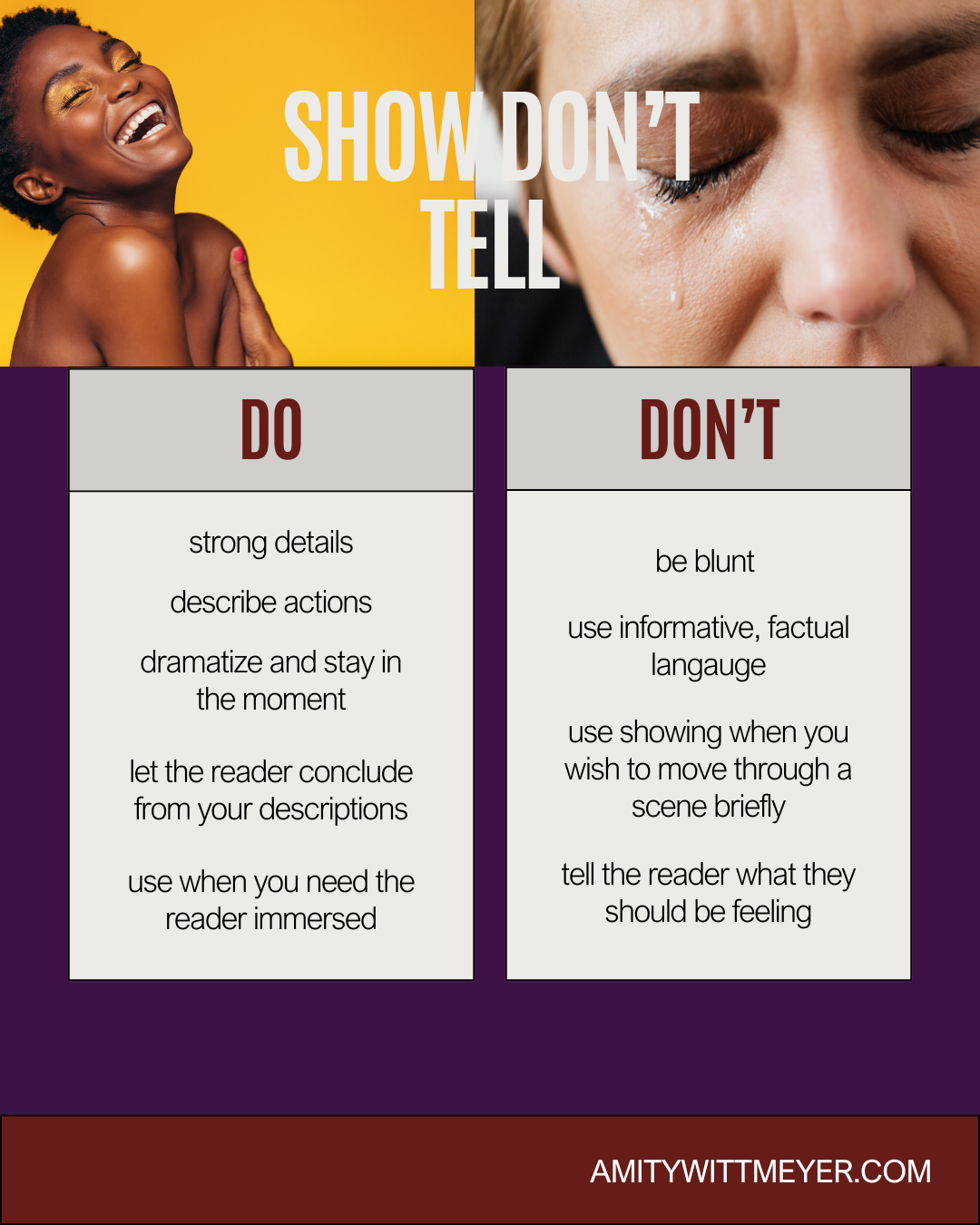
As you can see, showing is more detailed and immersive. When you wish to change a swift telling moment into a showing moment, here are some tips.
- Use sensual details
- Picture you are in the scene itself
- Utilize body movements and actions that help display emotion rather than bluntly stating them
- Have the moment play out in time, building each sequence of events
- Let your reader connect the dots on how your character is feeling through their actions
Changing Showing to Telling
Let’s start with a new scene. Showing is very important when you want to display information without stating it directly. However, if you are only showing the reader, you will actually lose their attention.
Showing is best used in moments you want to immerse your reader, emphasizing your character’s experience at intense moments. Therefore, if you wish to be factual, direct, and not indulgent in details, tell the reader.
Let’s change a drawn-out showing scene to a telling one.
Example
First, we’ll look at an example of showing and change it to help a passage flow smoothly and not drag on unimportant descriptions.
Throughout the day, she found her head full of racing thoughts, thoughts moving as swiftly as her heart, her hands, her legs, completing errands. On the car ride home, her finger tapped the steering wheel, and her foot was greedy on the pedals. She wiped her forehead and rubbed her damp hand on her pants before turning into her driveway to check on her children left alone with the new maids.
Now, while this showing example is still helpful to let the reader know your character is flustered with adrenaline for whatever awaits her, it is long and overindulgent with details that could be swiftly informed.
Changing to Showing
From the example above, let’s be swift and factual, saving the dramatic play-by-play details for another time.
She was anxious to leave her children alone with the new maids. In consequence, she completed her errands with unusual brevity before returning home.
Now, what do you notice? Here are some tips to look for when trying to change a scene from showing to telling and why:
- Is this moment essential for the reader to be immersed in?
- How long do you want to dwell on details for the scene?
- Does this point need to be emphasized or informative?
- Are you adding unnecessary details that simply lengthen your piece without helping the scene?
- Can this scene be rewritten and shortened to help the flow of the writing?
- Does this moment need to be brief and factual?
- Is this moment open for interpretation and layered symbolism, or simply basic facts the reader must know?
If you enjoy seeing how showing plays out in writing and want more examples, check out some short stories below!
Conclusion
To practice noticing the difference, grab a fiction book you can annotate. Flip to a page and highlight what is showing the reader in green. Highlight what is telling the reader in yellow. Then ask:
- How often is there green vs. yellow on the page?
- How does each choice the writer made help emphasize to the reader what they should pay attention to?
- Does each showing scene immerse you as the reader into what is happening?
- When the writer is telling you information, do you notice if it is necessary facts vs. dramatic descriptions?
- What would be the downfall of changing each moment of telling to showing? Or showing to telling?
To conclude, the showing and telling technique should both be used in your writing. Hopefully, now you understand why they are essential, their purposes, and when to use either.

Leave a Reply