Introduction
The Sheik by E. M. Hull is a desert romance that grew popular from its romanticism of kidnapping and Stockholm syndrome.
By the end of this blog post, you will have learned a plot summary and a deep analysis of this novel.
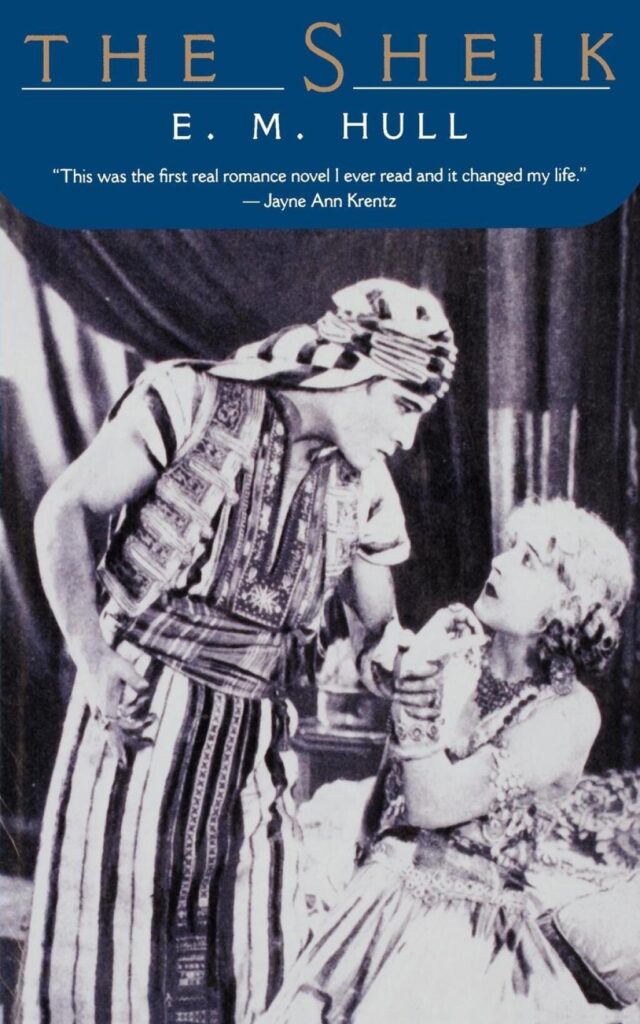
The Sheik Plot Summary
The Start
The Sheik centers around an English woman who solo travels across the Sahara desert and is kidnapped by a Sheik whom she falls in love with.
Diana Mayo is the orphaned daughter of a wealthy upper-class family who is raised by her stubborn brother, Aubrey, to pursue (at the time) male related activites. She spends her upbringing traveling across Europe, learning how to ride a horse, shoot a gun, and survive off the natural land.
The Hook
After turning 18, she determines to embark on her first solo expedition despite her brother’s warnings. On her escapade, her guides led her directly into the boundary dominated by the Sheik, Ahmed Ben Hassan, who kidnaps her.
Throughout the seven months she is in his control, Diana is brutally treated, raped, and told she will be “tamed” by Ahmed, like she is one of his infamous Arabian horses.
The Middle
Ultimately, after running away for a day to be captured again, Diana realizes her love for Ahmed.
Knowing that once his victims fall in love with him, he gets rid of them for their lack of appeal, she must hide her affections.
The Climax
Meanwhile, the rival Sheik, Ibraheim Omair, captures Diana one day on her normal horseback rides. In his captivity, she is nearly rapes when Ahmed arrives and kills him. He is then stabbed by one of Omair’s servents leading to a long recovery back at his camp, while Diana waits on him.
The Resolution
Ahmed realizes his affection for Diana and determines to remove her from his camp for her safety. She nearly commits suicide at this news until Ahmed comforts her crying body, and both finally resolve to marry one another and live happily ever after.
E.M. Hull and The Sheik's Popularity
The English author, Edith Maude Hull, wrote The Sheik in 1919. The novel was infamous for its significant influence on the desert romance genre.
According to The Sheik‘s afterword, Hull’s story was written
“Drawing from her fascination with the exotic and romanticized East, which was popular in Western literature and culture at the time. She may have been inspired by the escapist allure of desert landscapes and a desire to explore themes of power, mystery, and passion within a foreign setting.”
Hull’s story exemplified the Western/White European ideologys/views on foreign cultures, romanticizing “exotic” characters and forbidden love.
The Novel’s Success
As her debut novel, The Sheik rose in popularity, selling millions of copies, and influenced romantic fiction for the following decades. Written after World War I, the themes of forbidden love, captivity, and power dynamics were especially enticing to readers due to their dark romantic elements.
Equally celebrated and criticised, the world of readership couldn’t shut up about this novel, leading to more and more copies being sold. Many criticised its reinforcement of outdated gender roles, while others celebrated the lead female protagonist’s independent nature, pursuing hobbies typically dominated by men.
Desert Romance Genre
The desert romance genre is categorized as a dark romance novel centered around the forced abduction of a white woman by a brown man and the ultimate love they have for one another, normally set in North Africa or the Middle East.
Find more desert romances on Goodreads.
The Sheik's Backlash
While The Sheik reached success for its solidification of the desert romance genre, there are plenty of examples of themes inside that are deeply controversial and worthy of criticism.
Stockholm Syndrome
For starters, the main character, Diana, falls in love with her captor. As we see from the start of the novel, Diana has been raised “like a boy,” enjoying athletic, explorative endeavors not typical for women at the time.
She has a myriad of suitors who are inspired by her beauty to ask for her hand in marriage. However, Diana sees these men as weak and has no interest in romantic affairs, even continuously disregarding her own obvious beauty.
Meeting the Sheik
Diana is captured by the Sheik, whom she loathes for the first four months in his captivity. She stays his prisoner in his tent, continuously being raped by him. The novel describes her fear of his obvious physical strength over her repeatedly.
While it is never explicitly written that she is being raped, the novel continually mentions the Sheik, Ahmed, moving her body to lie next to him, look at him, force her to kiss him, etc.
The Sheik’s Motivation
The Sheik tells Diana he has taken multiple mistresses in the past, all of whom have been Arabs, for his pleasure. He wishes to “tame them” like his horses and make them fall in love with him. Once they do, he grows tired of them and discards them.
Diana’s absolute stubbornness from her upbringing entices the Sheik to continue to keep her longer than any of his past mistresses.
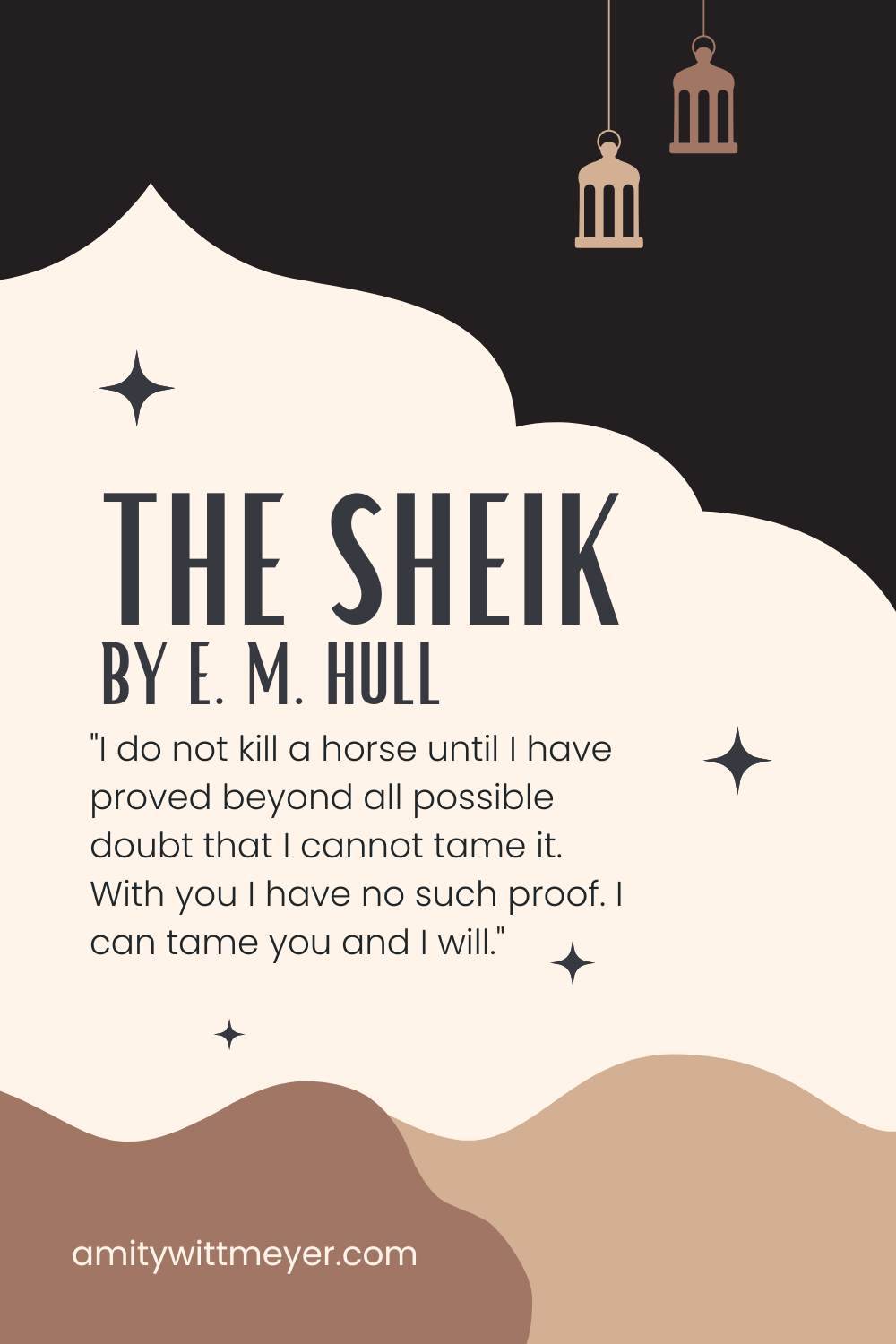
“You’d better kill me,” she said drearily.
“That would be to admit my own defeat,” he replied coolly. “I do not kill a horse until I have proved beyond all possible doubt that I cannot tame it. With you I have no such proof. I can tame you and I will.”
He mentions seeing Diana in the city of Biskra when she is planning her solo expedition and immediately falling for her beauty. As we learn later, Ahmed’s father was English and treated his mother horrifically to the point where Ahmed hates all English people. He wishes to exercise his hatred of them by capturing an Englishwoman and making her suffer for his entertainment.
Diana Mayo
To look further into why Diana falls for Ahmed, the Sheik, we need to look at why Hull wrote Diana as a stubborn, headstrong individual.
Her Upbringing
Diana has had the wealth and luxury to get what she wants all her life. She was raised without the love of parents, but instead the displeasure of a brother who only wanted to raise her to do activities he enjoyed.
“Marriage for a woman means the end of independence, that is, marriage with a man who is a man, inspite of all that the most modern women say. I have never obeyed anyone in my life; I do not wish to try the experiment.”
-Diana Mayo, The Sheik
Diana has never been interested in other men, as she herself is quite a strong, masculine individual who wouldn’t see other men as providers or desirable.
Fear and Submission
When she meets the Sheik, she is, for the first time in her life, forced to be submissive to another person. She must obey him, for she has no outside authority to help her get her way or the physical strength to ward him off. She is also afraid of him, and fear has, up until this point, been an undiscovered emotion for her.
Ahmed’s dominating personality grows intensely appealing to Diana, who discovers she enjoys his absolute protection.
Love Realized
Once Diana escapes on horse one day and is stranded in the desert thirsty and exhausted, she realizes her love for the Sheik, in deepest desire for him to rescue her.
Once he does and they return to his campsite, his love for her overwhelms her fear.
“I love him! I love him! And I want his love more then anything in Heaven and earth.”
-Diana Mayo, The Sheik
The drastic contrast of Diana’s morals from start to finish furthur reinforce the gender norms of the time. The message is clear: that a woman has to play the part of a submissive homebody to be saved by a man and get married. However, a woman can’t pursue “male-related” hobbies and adventures, wear pants and jackets, and be content with your individualist life.
Analysis of Stockholm Syndrome
The dark love elements of The Sheik are definitely a product of its time. The “exotic” setting and explored power dynamics are what make the love story tragic, appealing, and controversial.
The Contrast of Diana and Ahmed
Diana has never been a sexual being, aware of the desire to meet men or play the stereotypical part of a woman. She never even wore dresses until she was captured.
The Sheik’s masculine, dominating presence scares and repulses her. However, she continuously recognizes how handsome he is, and, ultimately, how strange it is that he makes her feel like a woman for the first time in her life.
He demands her obedience and physically controls her when she relents. He forces her to wear jade dresses and jade necklaces. When she responds negatively to both, he acts confused, as his past mistresses have desired even more luxurious items while being his kidnapped slaves.
Desire Awakened
Diana is suddenly overwhelmed with the new idea of being desired by a man who actually challenges and scares her. Her experience with other men has made her laugh at their hopes of marrying her. With Ahmed, she is forced to take on the role of a stereotypical woman and be provided for.
Intermittent Reinforcement
Additionally, Ahmed is very hot and cold. One day, he is ravenous to be around her and puts all his effort into getting her attention. Other days, he blatantly ignores her and doesn’t speak. This is called intermittent reinforcement, and it’s the same push and pull that leads to gambling addiction.
According to Helpful Professor’s article, “Intermittent Reinforcement: 10 Examples and Definition,”
“Rather than bestowing a reward each time an individual exhibits certain behavior, intermittent reinforcement awards the same action at random intervals, which can sustain suspense and prevent the extinction of a behavior.
This kind of respondent conditioning is powerful because it creates an element of unpredictability that can lead to persistent and repetitive behavior.”
Despite loathing him for the first four months, the Sheik’s hot and cold behavior makes Diana addicted to receiving Ahmed’s attention and approval constantly.
How the Sheik is Described
Another controversy that cannot be ignored is the blatant racist depiction of Ahmed Ben Hassan, the Sheik. He is described as Arabic, in charge of a section of the Sahara Desert where his army surveys and controls, while breeding and taming horses to sell.
It is clear, specifically to Diana, that he is physically attractive. The Sheik has a handsome face, strong physical attributes, and mesmerizing eyes.
Racist Analysis
However, the mention that he is Arabic is never far from these descriptions. Diana calls him a “beast,” “a savage,” “a brute,” and even “a dirty (n-word).” The Sheik even describes himself as being untamed, wild, and savage.
“I am a brute and a beast and a devil. You need not tell me again.”
-Ahmed, The Sheik
He enjoys his violent, hot temper and pleasures himself with kidnapping and raping women for his own amusement. He chose an Englishwoman as a form of redemption for the hatred he has of his English father’s treatment of his mother.
However, ultimately, he is extremely attractive to Diana. She continues to battle with these feelings of attraction since he is “a savage arab.”
The Sheik’s True Race
Later in the novel, once Saint Hubert, Ahmed’s childhood friend, visits and takes care of the Sheik, once he’s wounded, he tells Diana that Ahmed is actually half Spanish and half English. His mother died in the last Sheik’s protection after running from her abusive husband. The former Sheik raised Ahmed to be his predecessor and he grew up thinking he was Arabic until he was eighteen and told the truth.
Appealing to Her Readers
The reveal of his true ethnicity would be the most acceptable backstory for their love to be accepted in the public eye at the time this novel was published. The author played into the racism of the time toward Arab persons and biracial coupling.
Reading the novel today, there are more than a handful of descriptions and key choices Hull made in the novel that are worthy of cringing and alteration today.
Orientalism
The European views of the “exotic” Middle East/Africa influenced The Sheik heavily. The idea that a woman could travel to a foreign location, be kidnapped by a strong man, and ultimately marry him became a love trope unto itself.
The deeply troubling romanticism of these ideas minimizes the fact that this is a rape story with heavily racist descriptions of characters.
While this novel may have cemented the desert romance genre, it remains a story about a location the author knew very little about in a rose colored lense that only white readers would accept as possible and romantic.
Sheik Not Sheikh
The original word for an arab cheif is Sheikh, with an H.
To elaborate, a shiekh, according to Britannica, is an
“Arabic title of respect dating from pre-Islamic antiquity; it strictly means a venerable man of more than 50 years of age. The title sheikh is especially borne by heads of religious orders, heads of colleges, chiefs of tribes, and headmen of villages and of separate quarters of towns. It is also applied to learned men.”
The term Sheik has become the ulterior word with the new definition of, according to Merriam-Webster dictionary, a
“man held irresistibly attractive to young women.”
Spelling Change Origin
The change of spelling can be placed as the result of English translation. Westerners lost the h on the word as it was difficult for them to pronounce and spell. However, the new spelling led to the common mispronunciation of “sheek” instead of the original “shake.”
E. M. Hull’s novel The Sheik popularized the translated spelling and is now more commonly seen in Western societies and texts.
Final Thoughts of The Sheik
The novel may have greatly influenced the romance stories of the following decades, but today it is a product of its time, which should be a text used to study the fantasies of wealthy, ill-traveled white women. The power dynamics are deeply troubling, leading to a romanticism of rape culture and the idea that a woman will get rescued by a man whom she will marry.
The story may have elements of thrilling sexual tension, but the overlapping racist descriptions and character traits are not to be overlooked.
Recommendations
To recommend this novel would be to ignore the controversies necessary when discussing it and its impact. However, if you wish to study what was “exotic and erotic” after World War I to white Europeans, this novel is a great stepping stone for historical analysis, as its impact can still be seen today.
Related posts:
- Normal People: a Social Cry for Acceptance and Love
- The Best Winter Book Recommendations to Escape Cabin Fever
- Scariest Classic Horror Halloween Stories That Will Freak You Out
- Fear of the abnormal is the silent killer of the man transformed into a verminous bug: The Metamorphosis, full review and anaylsis

Leave a Reply