Fantasy Prompts
Just like any other prompt, fantasy needs practice. If you are just beginning to write and find you wish to invent whole worlds and new creatures, this genre may be perfect for you. By the end of this blog post, you’ll be better equipped on the fundamentals of this genre, as well as utilizing some writing prompts to practice.
“One day, you will be old enough to start reading fairytales again.”
― C.S. Lewis, The Chronicles of Narnia
What is the Fantasy Genre?
An excellent question. What books first come to your mind when you hear fantasy? Lord of the Rings? Narnia? Alice in Wonderland?
This genre, according to MasterClass’ article “What Is the Fantasy Genre? History of Fantasy and Subgenres and Types of Fantasy in Literature,”
“features magical and supernatural elements that do not exist in the real world (…) Speculative in nature, fantasy is not tied to reality or scientific fact.”
Fantasy is whimsical, freakish, enchanting, and original.
The Conventions
Fantasy doesn’t have to be set in a fake world. Your story can either take place in the real world with magical elements, start in the real world and transition to an imaginary one, or solely be set in your crafted universe.
Interestingly, many fantasy stories are inspired by myths and legends, becoming adapted on the page. Truly, fiction is made up, but normally those stories are shaped to expose a hidden lesson or symbol for the reader to uncover and relate to. The same goes for fantasy, just in a less obvious way.
In fantasy, stories typically introduce fantastical creatures and characters who encounter otherworldly elements and tasks to complete, ultimately unmasking real-world problems readers can relate to.
Examples of Fantasy Novels
While both fiction and fantasy have self-constructed storylines that don’t replicate real events, they are still distinct from each other. Consequently, it may be somewhat challenging to distinguish between the two genres.
To clear the confusion, here are some examples of fantasy novels:
- The Hobbit by J. R. R. Tolkien
- The Magician’s Nephew by C. S. Lewis
- A Court of Thorns and Roses by Sarah J. Maas
- American Gods by Neil Gaiman
Interested in more fantasy novels as your next recommended read? Check out the list below:
Analysis
So, what similarities do you notice about these novels? Perhaps their inventive creatures and landscapes. But also, have you noted how each novel’s story follows a different variation of what makes up a fantasy novel?
For example, you can have a story take place in a world you created with original, unworldly creatures from start to finish, like in The Hobbit and A Court of Thorns and Roses.
Perhaps you noticed that a fantasy can take place in the real world and jump into an alternate, invented one, like in The Magician’s Nephew.
Lastly, did you recall that American Gods takes place in the real world with mythical creatures and retold legends? That story is heavily influenced by Norse mythology.
Fantasy Dos and Don'ts
Fantasy is the ultimate genre for escapism. Truly, a lot of readers are looking for stories that take them out of their reality and into, if not more entertaining, a better one. Your creatures and worlds, despite being figurative, should come to life on the page.
Alongside your players and settings, fantasy is still an incredible genre to critique real-world problems in a bit of a flashier disguise. Even if your fantasy characters don’t understand classism, per se, your reader will if you guide them through the same conventions and reveal to them your commentary on that issue and others.
The Dos of Fantasy
- You need to introduce your characters slowly and when it is appropriate for your story to meet them. When you build each character slowly and precisely, your reader will care for them more deeply.
- When it comes to explaining the landscape of your fantasy map, be selective with what you show your reader. When you are picky about explaining, the story will have more questions left unanswered as your reader continues. They will pick up on them, motivating them to continue, to finally resolve them.
- Make sure you are keeping your characters very distinct from one another in terms of dialogue and their own needs/wants.
- Lastly, be careful with infamous mythological or fantastical beasts that have been used time and time again. If you must reuse an old idea, try to make their story as original as possible, by the setting or their goal, from those that already exist.
The Don’ts of Fantasy
Fantasy can involve a lot of creativity. Sometimes, you may become a bit overwhelmed by the layout of your world or the number of characters you wish to include in your story.
Remember: don’t overload your reader with the basics/conventions of your world from the start of your story. Many of the best books written in Fantasy are slow and suspenseful, with each chapter revealing a new rule or landmark in the fantasy realm.
In conclusion, let your reader put the bits together themselves. As a result, they will be more invested in the events that are taking place and your character.
Picture you’re watching a fantasy movie, and there’s a narrator who introduces every character. Additionally, they tell you how they know one another, what their goals are, and how the society they live in is restricting them from that goal. Oh, and finally, they walk you through every inch of the map of their world. You would fall asleep. Don’t write information overloads.
Important Note
You may be drawn to this genre because you think it may be easier to create a story from. You might assume you don’t need to do as much research and prep work to get an accurate, believable story, since in fantasy, you can make up elements and characters. This could not be further from the truth.
Again, a lot of fantasy books recreate stories/characters from mythology. Therefore, you need to take the time to understand the previous conventions of those beings. If you don’t, chances are your readers will, and they will not be forgiving of your lack of prep.
Lastly, you may want to create your own worlds in fantasy. However, that doesn’t necessarily make you a geologist, zoologist, or meteorologist.
How can you create a world without the basic knowledge of existing scientific facts?
Research
Ask yourself some questions relevant to the biome you wish to replicate or take inspiration from, like:
- How do mountains affect the neighboring land?
- How do rivers flow from place to place?
- How does the food chain work?
- What animals migrate, and how have they evolved?
- What happens in extreme weather to plants and sediment?
You can create your own world, but be cautious and vigilant to understand the real world too. You can draw inspiration from the history of Earth and its creatures when creating a map and a range of creatures.
If you don’t, your reader will notice inaccuracies and deem you lazy and unresearched.
Check out the published collection for fantastical short stories!
Fantasy Writing Prompts
Now, let’s practice this genre. Below are twenty fantasy prompts to get you started thinking abstractly and creating original creatures or a world of your own!
Confused about how writing prompts work? Look at the additional writing prompts for practice below.
Prompts
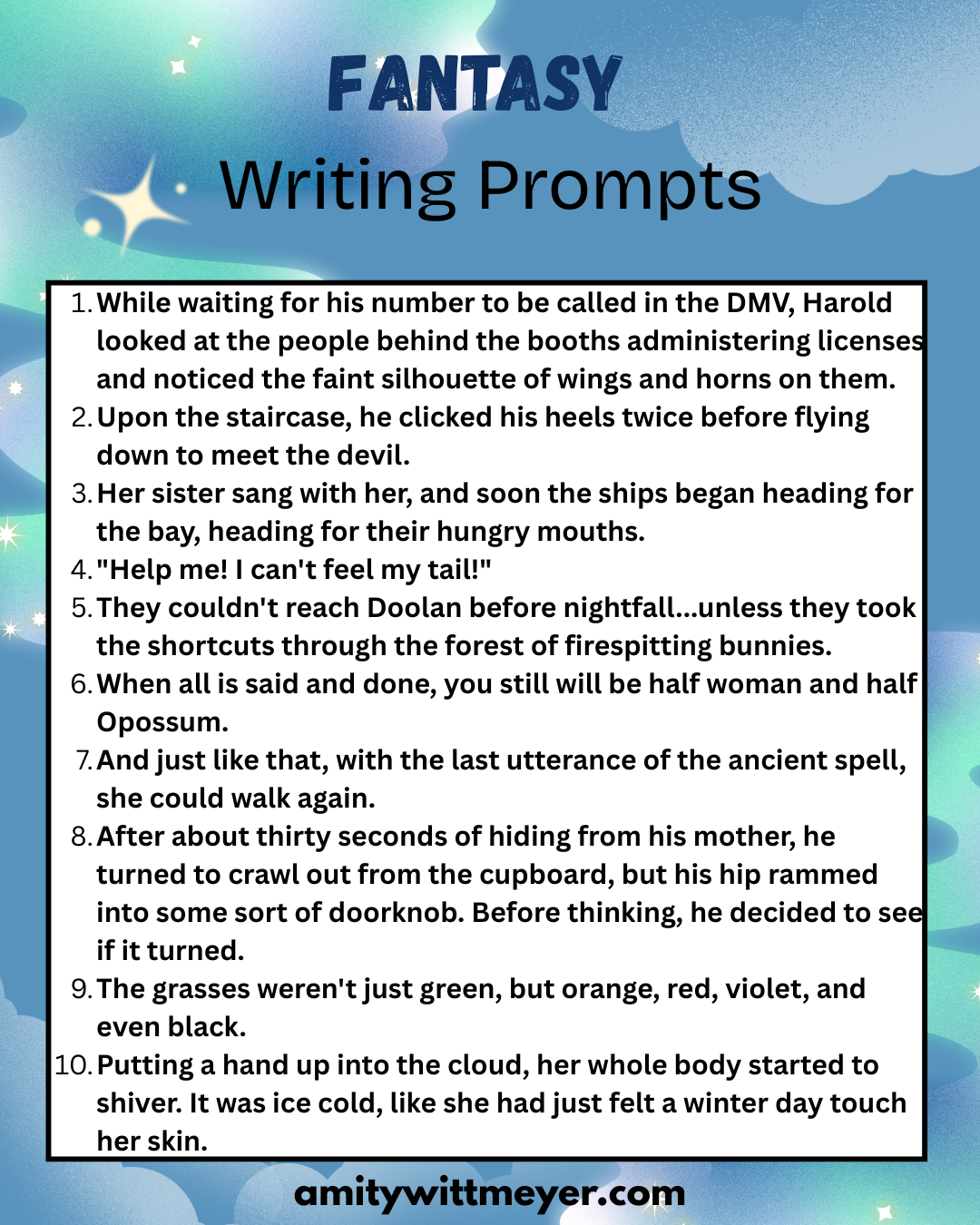
- While waiting for his number to be called in the DMV, Harold looked at the people behind the booths administering licenses and noticed the faint silhouette of wings and horns on them.
- Upon the staircase, he clicked his heels twice before flying down to meet the devil.
- Her sister sang with her, and soon the ships began heading for the bay, heading for their hungry mouths.
- “Help me! I can’t feel my tail!”
- They couldn’t reach Doolan before nightfall…unless they took the shortcuts through the forest of firespitting bunnies.
- When all is said and done, you still will be half woman and half Opossum.
- And just like that, with the last utterance of the ancient spell, she could walk again.
- After about thirty seconds of hiding from his mother, he turned to crawl out from the cupboard, but his hip rammed into some sort of doorknob. Before thinking, he decided to see if it turned.
- The grasses weren’t just green, but orange, red, violet, and even black.
- Putting a hand up into the cloud, her whole body started to shiver. It was ice cold, as if she had just felt a winter day’s chill on her skin.
- He leaped from the unicorn’s back and thanked her, calling to his brother to ready the flying tigers for war.
- In the volcano now, the tiny child finally opened its eyes. They were bright red, moving with the magma around her, and her hair smelled of ash and smoke.
- Never had this world’s buildings remained stagnant. They shifted and melted like the kaleidoscope of brush-stroked colors in a Van Gogh.
- When they surrounded the tiny being, their mighty voices were so loud that the rocks next to it trembled as much as them.
- She was walking underwater, reading an excellent new thriller, when a strange man with yellow flappers tried to take her picture.
- “Here, in hell, we like to take a sample from everyone to keep as a way to account for their machine of harm they caused during their life. It says here that your tongue shall be parted from you.”
- When the witch had finally turned her head, the girl grabbed a ladyfinger off her dusty desk and swallowed it. When the witch turned back, she was met with the pink snout of a peculiar pig.
- This planet doesn’t have laughter. It has been forbidden for many years.
- If I trade you for weapons, can I at least say goodbye to RJ before you roast and eat him?
- “I thought I saw something,” she whispered back to her friend, who clearly couldn’t see the eight-hundred-pound wolf creeping towards them.
Wrap Up
Enjoy utilizing these prompts to imagine and write your own fantasy story. Writing prompts are fun activities where mistakes are welcome, and creativity will be ignited. Fantasy is an incredible genre, one that takes the cake for readers who long to escape the norms of reality.
How will your story immerse your reader?
Leave a Reply